
In my years working in learning and development, I have had many conversations about what makes training work. We debate content, delivery methods, platforms, and ROI frameworks. But I do not often hear people talk about what happens before any of that—the personal foundation that determines whether a learner can even absorb and apply what they are being taught.
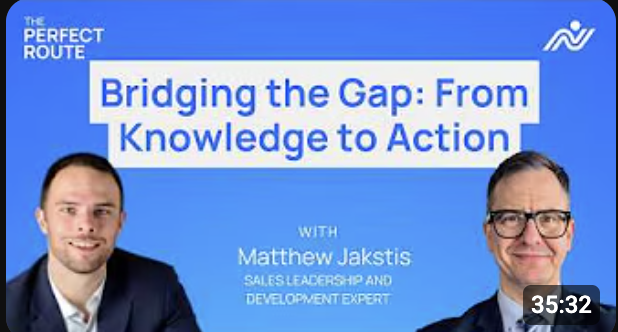
That changed when I sat down with Matt Jakstis on The Perfect Route. Matt has built his career across real estate, clinical psychology, sales, sales leadership, and executive coaching. What ties it all together is a fascination with how people grow—and a growing conviction that organizations chronically underinvest in the fundamentals.
His metaphor is simple and memorable: if you want to know how tall a building will be, look at how deep the foundation is. You cannot build a skyscraper without first digging a serious hole and pouring a lot of cement. The same is true for professional development. Sleep, nutrition, movement, emotional resilience, and a sense of purpose at work are not nice-to-haves. They are the substrate on which everything else depends.
Measuring What Actually Matters
Matt works inside a fast-growing sales organization, and he thinks carefully about measurement. On the hard side, his team tracks the metrics most sales leaders know well: revenue, close rates, average order value, churn, and individual performance trends. These numbers are useful not just for assessing results, but for targeting development. If someone’s average order value is consistently below the team average, that gap points directly to a skill area that needs attention.
But Matt is equally interested in the softer metrics—culture fit, team cohesion, the degree of ownership individuals take over their own growth. And he is particularly enthusiastic about seeing more rigorous measurement of how wellness initiatives translate into outcomes like reduced turnover and improved performance. His hypothesis is that the data will eventually make a compelling case for investing in the whole person, not just the technical skill set.
AI-Powered Personalized Learning
One of the most concrete parts of our conversation was about what Matt is actively building in his organization right now. His focus is on AI-driven, adaptive learning pathways that can assess individual skill gaps, simulate real sales scenarios, deliver personalized feedback, and give leadership a dashboard view of where the whole team stands. The goal is not to replace the human trainer or manager—it is to give them back their time so that when they do engage directly with a team member, that interaction can be targeted and high-impact.
I found this genuinely exciting. One of the most stubborn problems in organizational learning is the gap between what leadership knows needs to happen and how much time they actually have to make it happen. Adaptive AI does not close that gap entirely, but it does a remarkable job of handling the personalized practice and feedback loop that used to require a human to be in the room. That frees up the human to focus on what only a human can do: read the context, build the relationship, and make the nuanced judgment call.
Making Mandatory Training Worth Taking
No list of learning challenges would be complete without the elephant in the room: mandatory training. Matt approaches this with what he calls the knowing-doing gap. Most people in organizations know, at some level, what they should be doing. The challenge is that knowing does not automatically produce doing. Bridging that gap requires more than better content or stricter enforcement.
Matt referenced a well-known social psychology study in which people were significantly more likely to comply with a request when given a reason—even a weak or obvious reason. The lesson for training is practical: when leaders take the time to explain why an initiative matters, not just announce that it is required, engagement climbs. Co-creation matters too. Inviting people to weigh in on what they need and what would actually help them builds a kind of ownership that top-down mandates simply cannot manufacture.
The Culture That Makes Learning Stick
What came through most clearly in my conversation with Matt is that all of this—AI, metrics, training design, wellness—only works inside a culture that supports it. He talks about what he calls the CEO mindset, the disposition to take ownership of everything within one’s sphere of influence rather than waiting to be told what to do. When this becomes the default behavior across a team, fewer problems escalate, more people actively seek out learning, and the organization gains real momentum.
He also pointed to research by Teresa Amabile at Harvard Business School, which identified consistent progress as the single most important contributor to quality of work life. Not recognition. Not pay. Progress. Learning and development, at its best, is how organizations give people the conditions to make that progress every single day.
Matt Jakstis is the kind of practitioner I find most valuable to talk with: someone who has done the work across multiple contexts, is genuinely curious about what drives performance, and is not afraid to challenge the conventional prioritization of skills over foundations. If you work in learning, leadership, or organizational effectiveness, I think you will find his perspective worth sitting with.
Watch the podcast here:
- Spotify: https://open.spotify.com/show/1hA8r9Pa15WbjG6AX4Apgn?si=e9ee76b431c14efb
- Apple: https://podcasts.apple.com/us/podcast/the-perfect-route/id1834640871
- Youtube: https://www.youtube.com/@BillSodemann3ed
- Website: https://n3ed.com/

Comments are closed